
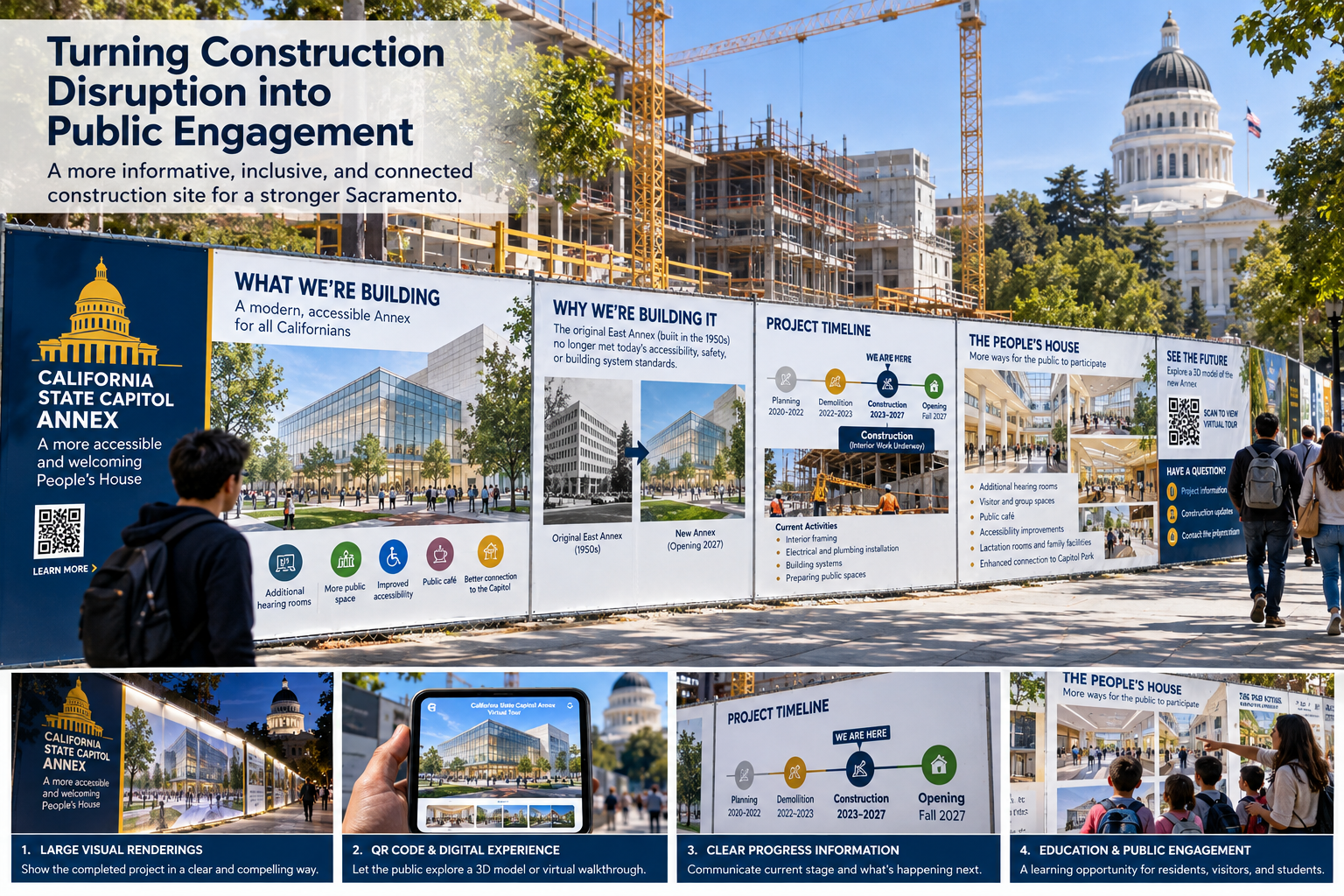
Anyone who regularly travels through downtown Sacramento has probably experienced it: fencing, detours, blocked pathways, construction equipment, altered traffic patterns, noise, and a landscape that seems to remain unfinished month after month.
Construction is an unavoidable part of a changing city. Roads must be repaired. Transit systems must be improved. Utilities must be replaced. Public buildings must be renovated or reconstructed.
But there is another question that receives much less attention:
Must the public experience major construction primarily as disruption?
The ongoing reconstruction of the California State Capitol Annex provides an interesting opportunity to ask that question.
The project is substantial. The previous East Annex, built in the early 1950s, had accessibility, safety, technological, and building-system deficiencies. The replacement is intended to provide modern hearing rooms and more visitor space, improve accessibility, modernize infrastructure, and strengthen public access to the legislative process.
According to the official project site, as of July 2026 the building was primarily weathertight, interior drywall and mechanical, electrical, and plumbing work were underway, and completion remained targeted for fall 2027. The project also reported $668 million spent as of July 2026.
The finished building may substantially change the visitor experience. But before there is a finished building, there are years of construction. Those years are also part of the public's experience of the built environment.
The View from Outside the Fence
Imagine someone who works downtown and passes the Capitol regularly. Perhaps this person is not an architect, planner, construction professional, government employee, or legislative staff member. They simply drive, walk, bicycle, or take transit through the area as part of everyday life.
They see construction barriers. They encounter detours. They watch cranes moving above the site. They experience inconvenience.
But what do they know about what is happening behind the fence?
Do they know what the completed building will look like? Why the previous Annex needed replacement? Which spaces will be available to ordinary Californians? What stage construction has reached? When particular disruptions may end? What public benefits are intended?
These questions are especially relevant because the project already provides many of the answers. Its official website includes project explanations, renderings, milestones, FAQs, and descriptions of public-access improvements.
The story exists. The more interesting question is whether enough of that story exists where people experience the construction.
Information Available Is Not Necessarily Information Encountered
A public agency can maintain a detailed website with reports, schedules, renderings, and FAQs. Technically, the information is publicly available.
But availability still requires the public to take another step. Someone must know the website exists, decide to search for it, find the relevant page, and spend time reading it. Most people passing a construction site will understandably never do that.
The construction site, meanwhile, already has their attention.
Instead of asking only, “Where can the public find information about this project?” we might also ask, “How can information about the project find the public?”
What If the Construction Fence Became an Interface?
Construction fencing is normally understood primarily as a boundary. On one side is the project; on the other is the public. Its essential functions—safety, security, and separation—are necessary.
But a long construction perimeter is also a large public surface. What if part of that surface were deliberately designed as an interface between the project and the community?
What are we building?
A large, compelling visualization of the completed project—not a technical construction drawing, but an image immediately understandable to someone walking past.
Why are we building it?
A concise explanation of the problem the project is intended to address.
What will the public get?
A visual explanation of future public spaces, accessibility improvements, transportation improvements, parks, community facilities, or other benefits relevant to the project.
Where are we now?
A simple construction timeline—planning, demolition, structure, enclosure, interior, landscape, opening—with a clear “You Are Here” marker.
What is happening behind this fence?
A periodically updated panel could explain current activities in plain language: interior framing, electrical work, utility relocation, landscaping, or other visible and invisible phases.
What will this place look like?
A QR code could open a short animation, 3D model, virtual walkthrough, or other digital visualization. The technology need not be extravagant; the purpose is to help non-specialists connect today's disruption with tomorrow's place.
How will this affect you?
Upcoming road closures, pedestrian rerouting, noisy work periods, and other disruptions could be explained in straightforward language.
Ask, comment, learn more
A direct digital connection could lead to project information, accessibility resources, questions, or appropriate public-engagement channels.
From Construction Hoarding to Public Infrastructure
This idea is not without precedent. The London Borough of Tower Hamlets, for example, treats construction hoardings as part of the public-realm experience. Its current guidance for major projects addresses maintained greenery, community and school art, educational information, and even viewing windows where appropriate. The point is not that Sacramento should copy another city, but that construction boundaries can be intentionally designed rather than treated as visually and informationally neutral.
Sacramento itself already uses multiple engagement tools in planning. The City's Streets for People program combined online mapping, multilingual materials, community engagement, and an animated public-information video. That demonstrates the value of taking information to people in different formats rather than relying on a single channel.
The opportunity is to extend that principle from planning engagement into construction engagement.
The Psychological Dimension of Disruption
A detour remains a detour whether someone understands the project or not. Construction noise does not become quieter because a rendering is displayed nearby. A closed sidewalk remains inconvenient.
Public communication should therefore never substitute for competent construction management, realistic scheduling, accessibility, traffic planning, fiscal accountability, or responsiveness to legitimate concerns.
But uncertainty can compound inconvenience. When people repeatedly encounter disruption without understanding its purpose, duration, progress, or intended outcome, construction can appear simply as an obstacle.
Visualization and timely information cannot remove the burden, but they can change the informational relationship between the project and the public.
The Capitol Annex: An Especially Interesting Case
The Capitol Annex is particularly compelling because the project itself describes public access and participation as central goals. Official project information says the new building is intended to eliminate accessibility barriers, provide additional hearing rooms and public space, and include amenities such as a public café, lactation rooms, respite areas, restrooms, and public elevators.
The project FAQ says the building is expected to serve an estimated two million people—including tourists and schoolchildren—who visit to meet elected officials, advocate, learn, and attend events.
Those ambitions make transparency especially relevant. Not because signage or visualization can resolve disagreements over cost, schedule, design, or management. They cannot. Rather, a highly visible civic project offers an opportunity to ask whether physical transparency and informational transparency can reinforce one another.
A building intended eventually to strengthen civic engagement could begin doing some of that work before its doors open.
Imagine the Capitol Construction Walk
Consider a modest experiment: a portion of the Capitol construction perimeter becomes a temporary public exhibition.
Not advertising. Not political messaging. Not a promotional claim that everything about the project is perfect.
Instead, it becomes an evolving explanation of a public project.
A visitor begins with The Capitol Annex: Why It Is Being Rebuilt, followed by images and a simple explanation of the previous building's limitations. Next comes The New Annex, with a large architectural visualization. Then The People's House, identifying areas intended for public use. Another panel explains what is happening inside the construction site today and what comes next.
The construction story could also introduce the people building it. The project reported surpassing one million work hours in 2026, involving more than 3,360 tradespeople. A construction perimeter could therefore become an informal architecture, engineering, trades, and civics exhibit as well as a project update.
A school group passing the site gains a learning experience. A tourist understands why part of the Capitol grounds looks the way it does. A worker who passes every morning can see progress. A Sacramento resident can better connect years of disruption with the place being created.
The construction fence becomes something unexpected: a temporary civic institution.
Beyond the Capitol: A Public Construction Communication Layer
The larger opportunity extends well beyond one building. Sacramento and other metropolitan areas continually experience road reconstruction, utility replacement, transit improvements, housing construction, park redevelopment, bridge work, and other infrastructure projects.
We propose a simple framework—a Public Construction Communication Layer—built around five questions:
Purpose: Why are we doing this?
Future: What will it look like or enable when completed?
Progress: Where are we now?
Impact: What inconvenience should people expect, and for how long?
Connection: Where can people learn more, ask questions, or participate where participation is appropriate?
The exact medium should vary with the project. A short street repair does not need an augmented-reality installation. A multiyear civic project may justify much more.
The scale of public communication should bear some relationship to the scale and duration of public disruption.
Designing the Process, Not Only the Project
This brings the discussion back to a recurring theme in Sacramento Collaborative's Built Environment work.
Architecture and planning understandably focus considerable attention on the physical product: the building, street, neighborhood, infrastructure, or landscape. But the built environment is also produced through processes, and people encounter those processes long before they encounter the completed architecture.
This is where the distinction between design process and process design becomes useful.
A design process describes how a project moves toward a physical solution. Process design asks whether the relationships, information flows, opportunities for participation, and interactions among actors can themselves be deliberately designed.
The physical object may already have been designed. But the relationship between that project and the public during three or four years of construction can still be designed.
Who receives information? When? In what form? At what location? Can nonexperts understand it? Can children understand it? Can someone understand the project without searching through a government website? Can people see progress? Can disagreement and uncertainty be acknowledged? Can questions be directed somewhere meaningful?
These are design questions too.
From Public Burden to Public Learning
Large public projects will inevitably create inconvenience. No communication strategy can eliminate that reality. Nor should attractive architectural renderings be used to obscure legitimate questions about budgets, schedules, environmental impacts, design decisions, or construction management.
Meaningful transparency requires the opposite: communication should include challenges and changes as well as accomplishments.
But perhaps we have accepted too easily the idea that the years between groundbreaking and ribbon cutting must constitute a blank period in the public life of a project.
They need not.
Construction can also become an opportunity for learning, visualization, civic education, public understanding, and—where appropriate—continued engagement.
Beyond the Fence
The question raised by the Capitol construction is therefore larger than: When will this project finally be finished?
A more interesting question may be:
How should we experience the years while it is being built?
A construction fence has to separate. But it can also communicate.
A construction site has to protect. But it can also teach.
A public project has to build. But perhaps it can also invite people to understand what is being built in their name.
When the public shares the disruption of building the future, perhaps the future should be made visible to them.
The finished building matters. So does the journey toward it.
Sources & context
- California State Capitol Annex Project — official project site
- California State Capitol Annex — About the Project
- California State Capitol Annex — Frequently Asked Questions
- California State Capitol Annex — project background and planning study
- City of Sacramento — Streets for People
- London Borough of Tower Hamlets — construction coordination and hoardings
Editorial note: The construction-fence visualization accompanying this article is a Sacramento Collaborative concept image. It is not an official rendering or proposal of the State of California.