
Sacramento Collaborative began with a simple proposition: meaningful solutions rarely emerge from one discipline, one institution, or one point of view.
Cities, universities, technologies, businesses, communities, and the people who live and work within them are interconnected. Yet the systems created to understand their problems are often separated—by profession, institution, geography, economic interest, or expertise.
Sacramento Collaborative seeks to work across those boundaries.
At this early stage, we remain a small and developing organization. Our resources are limited. Some initiatives are already producing tangible results; others remain research questions, conceptual models, or proposals. Rather than disguise that reality, our roadmap begins with it.
We intend to start with what we can do now: listen carefully, investigate systematically, imagine alternatives, and demonstrate possibilities. Promising ideas can then attract collaborators, resources, and funding and, where appropriate, grow into working platforms, programs, and real-world experiments.
But one principle runs through all four:
Collaboration is not the final step. It should be present at every step.
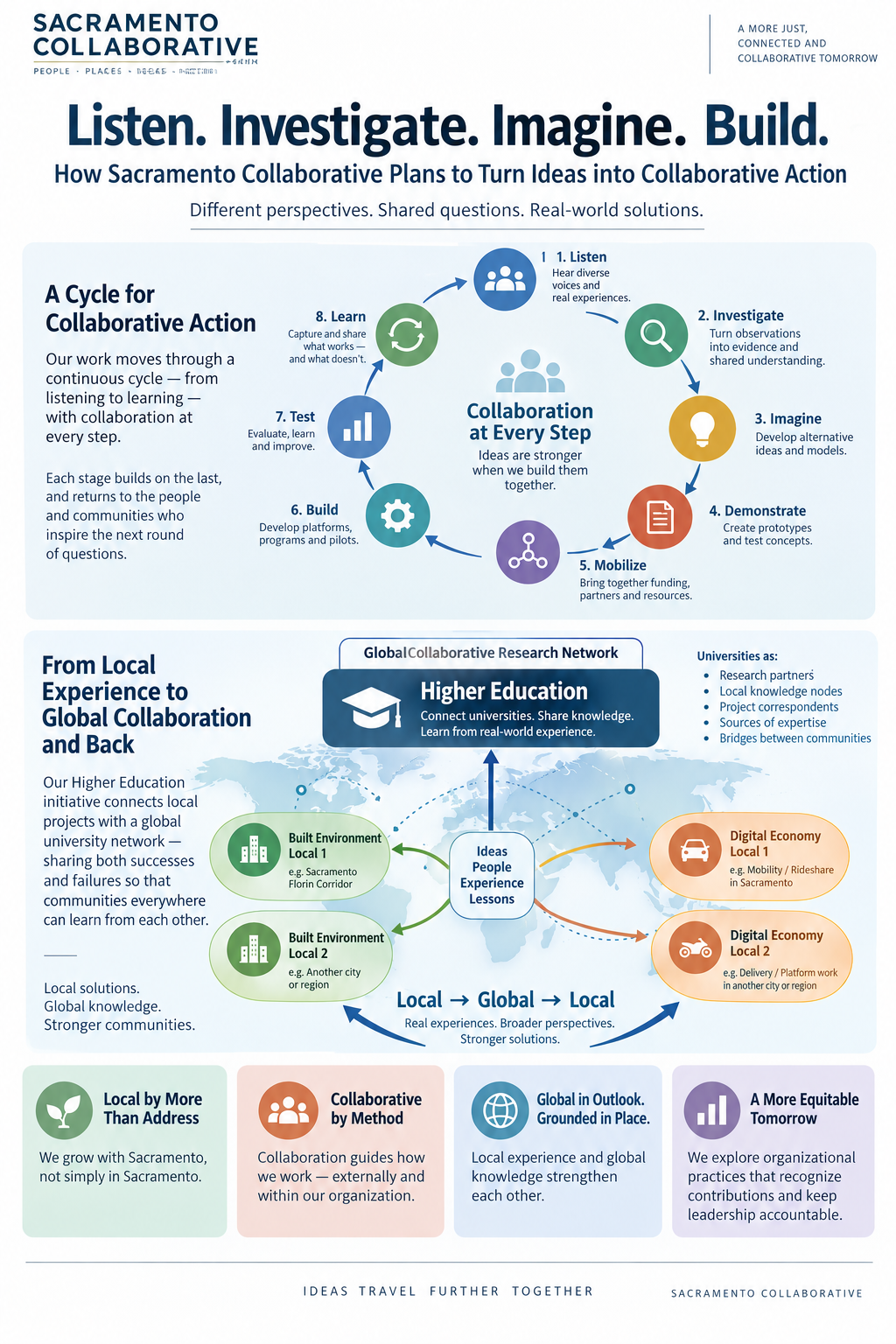
Listen: Begin with people, not predetermined answers
Research commonly begins with a research question. Planning begins with a problem statement. Business development begins with an opportunity.
Sacramento Collaborative wants to begin one step earlier: by listening.
People experience systems differently from the institutions that administer, study, or design them.
A resident struggling to afford housing sees the city differently from a housing economist. A rideshare driver experiences a digital platform differently from its developer or investor. A passenger encounters another side of the same transaction. A university student experiences higher education differently from a ranking organization or university administrator. A neighborhood resident knows things about a street that may never appear on a planner's map.
No single perspective provides the complete answer. But each may contain something worth investigating.
This is one reason Sacramento Collaborative created Everyday Voices—to recognize observations encountered in ordinary conversations and public discussions. We do not highlight these voices necessarily because we agree with every word, but because an ordinary observation can expose a question that formal analysis has overlooked.
Listening, however, is not evidence by itself. It is the beginning of inquiry.
A voice can lead to a question. A question can lead to investigation.
Investigate: From experience to knowledge
Sacramento Collaborative currently organizes its work around three broad fields: Higher Education, Built Environment, and Digital Economy.
These are not intended to become three isolated departments. They provide different environments in which we can investigate established systems, examine relationships among their participants, and explore alternatives.
Their geographic dimensions, however, are not identical.
Much of our emerging work in the Built Environment and Digital Economy begins locally. Cities, neighborhoods, transportation systems, development projects, workers, businesses, and communities operate within particular social and institutional contexts.
Higher Education offers something different. It gives Sacramento Collaborative a potential bridge between local experience and global knowledge.
Higher Education: From ranking universities to connecting them
Sacramento Collaborative's World Class University initiative is currently the most visible product of the Higher Education pillar.
But producing another university ranking is not the ultimate objective.
Rankings attract attention. Students read them. Universities monitor them. Governments and institutions use them. Their apparent simplicity makes complicated higher-education systems accessible to a broad audience.
Our WCU initiative uses that interest as an entry point.
By bringing several major international ranking systems into a common analytical framework, the project can reveal differences that deserve further investigation—not only among universities, but among higher-education systems and the environments in which those universities operate.
The WCU Index, in particular, can make disparities between countries and higher-education systems more visible.
For Sacramento Collaborative, however, documenting those gaps should lead to a larger question: What can we do with that knowledge?
A ranking can describe relative position. It cannot, by itself, create the relationships through which institutions learn from one another.
Competition can tell us who stands where. Collaboration can ask where we might go together.
Over time, we envision the Higher Education pillar extending beyond ranking and analysis toward a global collaborative research network.
In such a network, universities would no longer appear simply as institutions being measured. They could become correspondents, research partners, sources of expertise, hosts of local investigation, and bridges connecting knowledge among communities in different parts of the world.
And collaboration should not be understood as knowledge flowing in only one direction.
A university with greater financial resources or international visibility may have research capabilities from which others can learn. But a university operating in an emerging economy may possess decades of practical knowledge about informal urbanization, community development, low-cost construction, transportation, disaster recovery, entrepreneurship, or other conditions that universities in wealthier environments may rarely encounter in the same way.
Conventional ranking position does not determine the value of local knowledge.
The longer-term question behind WCU is therefore not simply: Which universities are world class?
It is also:
What might universities accomplish if being connected to the world mattered as much as being ranked within it?
Local → Global → Local
This is where Higher Education begins to connect Sacramento Collaborative's three pillars.
Built Environment and Digital Economy projects will often begin in particular places. Their purpose is not to create a Sacramento solution and then declare it universally applicable.
Instead, local experiments can become sources of knowledge.
Imagine that Sacramento Collaborative develops and tests a new participatory planning method along the Florin Corridor. Some parts work. Others fail. Residents respond differently than expected. A method for negotiating among stakeholders proves effective; another creates confusion.
That experience should not remain only a Sacramento story.
Through university collaborators, researchers elsewhere might examine the experience and ask what—if anything—is relevant to their own communities. A university in another country might adapt part of the process to a very different neighborhood. Its experiment would inevitably produce different results. Those results could then travel back through the network.
Sacramento learns from another locality just as another locality learned from Sacramento.
The same principle can apply to Digital Economy experiments involving mobility, delivery, platform work, community ownership, or other emerging systems.
And then the cycle continues.
Success matters. Failure matters too.
A failed experiment can be valuable collaborative knowledge when its assumptions, process, and consequences are understood and openly shared.
This is not the circulation of universal “best practices.” It is the circulation of experience from which others can learn.
Imagine: Move from criticism to alternatives
Identifying problems is necessary, but criticism alone does not build alternatives.
Housing can be unaffordable. Gig workers can experience insecurity. Digital platforms can concentrate economic power. Public participation in planning can become superficial. Universities can compete for international standing while opportunities for meaningful collaboration remain underdeveloped.
Sacramento Collaborative wants its research eventually to ask another question: What could be done differently?
That is where investigation becomes imagination—not imagination detached from evidence, but imagination informed by what we have learned.
Our short-term strategy therefore emphasizes concepts, prototypes, and demonstrable models.
Built Environment: From Street Studio to collaborative planning
Our earlier work on the Florin Corridor introduced the concept of Street Studio: bringing the city into the design studio rather than treating communities simply as subjects of professional design.
The next step is to explore how that principle might operate through a collaborative planning and design platform.
A potential site or manageable study area along the Florin Corridor could provide the demonstration case.
Instead of professionals developing a largely completed proposal and subsequently asking the public to react to it, the platform would explore how residents, businesses, property owners, community organizations, public agencies, planners, designers, developers, academics, students, and other stakeholders might participate throughout the planning and design process.
They will not necessarily agree. That is precisely why collaboration is needed.
Collaboration does not mean eliminating differences. It means designing a process through which different interests, knowledge, experiences, and proposals can encounter one another constructively.
At the conceptual stage, Sacramento Collaborative does not need to build a complete technological platform.
We can first demonstrate its architecture: who participates, how information enters the process, how ideas become alternatives, how competing priorities become visible, how responses are recorded, and how proposals evolve.
The Florin case can therefore become both an urban design experiment and a prototype of collaborative process.
Digital Economy: From users of platforms to participants in them
The Digital Economy pillar raises a related question in a different environment.
Digital platforms have transformed transportation, delivery, work, commerce, and everyday interaction. They can offer remarkable convenience and flexibility while also raising questions about who controls the platform, who creates its value, how that value is distributed, and how much influence participants have over the systems on which they increasingly depend.
Our emerging rideshare and delivery research asks whether alternative relationships are possible.
Can a platform be designed around a more balanced relationship among those providing and using a service?
Could drivers, riders, workers, customers, local communities, and technical partners participate more meaningfully in shaping the system?
Again, Sacramento Collaborative does not claim to possess the finished answer.
The immediate task is to investigate existing models, listen to the people experiencing them, understand both successes and failures, and develop a concept sufficiently concrete to be examined.
The longer-term possibility is a locally grounded prototype that, with appropriate partners and resources, could eventually become a functioning platform and real-world pilot.
Demonstrate before asking others to believe
As a young organization, Sacramento Collaborative cannot begin every initiative by constructing expensive technology or large organizational structures.
Nor do we believe every idea should begin with a request for someone else to finance something that exists only on paper.
Where possible, we want to demonstrate before asking others to believe.
WCU provides an early example. Start with available resources. Develop the methodology. Assemble the information. Create something people can examine. Publish it. Learn from criticism. Improve it.
Built Environment can demonstrate the architecture of collaborative planning before building the complete platform.
Digital Economy can develop and test an alternative platform concept before attempting a full application.
A prototype does not pretend that the final solution already exists. It makes an idea visible, discussable, testable, and improvable.
Mobilize: Funding is only one resource
Once an idea becomes sufficiently developed, Sacramento Collaborative can move into the next stage: mobilization.
Funding will matter. Projects may require grants, philanthropic support, research funding, technical investment, or other financial resources.
But money alone does not create collaboration.
We will also need community relationships, university partners, public institutions, researchers, students, professionals, technology expertise, businesses, and—most importantly—people willing to participate.
Our objective should therefore be broader than funding mobilization. It is resource and relationship mobilization.
Instead of approaching a prospective partner with only an aspiration, Sacramento Collaborative should increasingly be able to say:
Here is the problem we have been investigating.
Here is what we have learned.
Here is an alternative we are exploring.
Here is an initial demonstration.
Here is what we still do not know.
Would you help us take the next step?
Build: From concepts to platforms and pilots
Some initiatives will eventually be ready to move beyond conceptual prototypes.
For Higher Education, this could mean developing a collaborative research platform connecting universities and locally grounded projects across different regions.
For Built Environment, it could mean turning the conceptual participation model into a functioning collaborative planning and design platform and testing it through an actual project.
For Digital Economy, it could mean application development and a limited real-world mobility or delivery pilot involving users, providers, technical collaborators, and community partners.
Not every idea will reach this stage.
Some may prove impractical. Evidence may contradict our assumptions. Communities may identify priorities different from ours. Funding may not materialize. A prototype may need to change substantially—or be abandoned.
That should not automatically be considered failure.
An organization that genuinely investigates must permit what it learns to change what it does.
Collaborative is not our label. It is our method.
There is a principle behind this roadmap more important than any individual project.
The word Collaborative should never become merely part of our name, branding, or promotional language. It must describe how we work.
If Sacramento Collaborative builds platforms intended to broaden participation while its own decisions eventually become concentrated among a few people, something has gone wrong.
If we advocate listening to communities but become unable to listen within our own organization, something has gone wrong.
If we investigate economic systems in which those performing everyday work have little security or participation in the value they create, yet eventually reproduce extreme inequalities within Sacramento Collaborative itself, something has gone wrong.
We should not advocate collaborative systems for others while building a deeply unequal system for ourselves.
This does not mean every person must perform the same role, possess identical authority, or receive identical compensation. Different expertise, responsibilities, commitments, and levels of accountability reasonably produce differences.
But difference does not have to become distance.
As Sacramento Collaborative grows, we intend to explore governance, participation, recognition, and compensation practices that keep leadership accountable and recognize contributions throughout the organization.
We do not need to establish an arbitrary compensation formula today for an organization that does not yet exist at that scale.
But we can establish the principle today:
Nobody who helps build Sacramento Collaborative should be treated as insignificant to it.
Collaboration must happen not only between organizations, but also within ours.
Localism: Grow with Sacramento, not simply in Sacramento
Our global aspirations do not diminish the importance of place.
Sacramento should not merely be the address beneath the organization's name.
Sacramento Collaborative should grow with Sacramento, not simply in Sacramento.
The region gives us communities, institutions, neighborhoods, businesses, workers, students, technologies, challenges, and everyday experiences from which questions can emerge and ideas can be tested.
Localism, however, should not become isolation.
This is precisely where our Higher Education network can become important.
A locally developed idea can enter a global conversation without becoming a universal prescription. Knowledge developed elsewhere can return to Sacramento without being imported uncritically.
The principle remains: local → global → local.
Local experience informs global exchange. Global exchange enriches local understanding. And each locality retains the right to interpret, adapt, reject, and reinvent what it learns.
In that sense, local does not mean small. It means grounded.
Build with people, not merely for them
Eventually, the success of Sacramento Collaborative should not be measured simply by the number of articles published, rankings produced, applications developed, grants received, or projects launched.
A more meaningful question will be: Did collaboration change the outcome?
Did somebody participate who otherwise would not have been heard?
Did one discipline learn something from another?
Did a university in one part of the world learn from an experiment somewhere else—and contribute knowledge in return?
Did a worker or user help shape a platform rather than simply being expected to use it?
Did a community influence a design before the important decisions had already been made?
Did an unsuccessful experiment prevent somebody elsewhere from repeating the same mistake?
Those questions return us to where this roadmap began.
Listening.
A roadmap, not a promise
This document is not a prediction that Sacramento Collaborative will build three platforms within six months.
Nor is it a declaration that every concept described here will become a funded project.
It is a direction.
Sacramento Collaborative is still near the beginning of its development. Moving toward sophisticated platforms, sustained research programs, global university relationships, and real-world pilots will require capabilities and resources we do not currently possess.
That is precisely why the sequence matters.
Investigate before proposing.
Imagine before investing.
Demonstrate before scaling.
Mobilize people as well as money.
Build when the evidence, relationships, and resources are ready.
And when something has finally been built?
Listen again.
Because a collaborative process should never end with those who designed a system announcing that the problem has been solved. It should return to the people experiencing it.
Across that cycle runs another movement:
One describes how ideas develop. The other describes how knowledge travels. Collaboration connects them.
Sacramento Collaborative is still near the beginning of both journeys.
And perhaps that is exactly where a collaborative organization should begin—not by claiming to have all the answers, but by creating better ways for people to search for them together.
An invitation to collaborate
If these questions connect with your work, community, institution, or experience, Sacramento Collaborative welcomes conversation across Higher Education, Built Environment, and Digital Economy.
Build with people, not merely for them.